Why it exists
I wanted to get comfortable with Python and interview-style problems. Reading solutions did not make me write code, and a plain problem list was easy to drop.
Portfolio / CASE STUDY
Public tower defense learning game
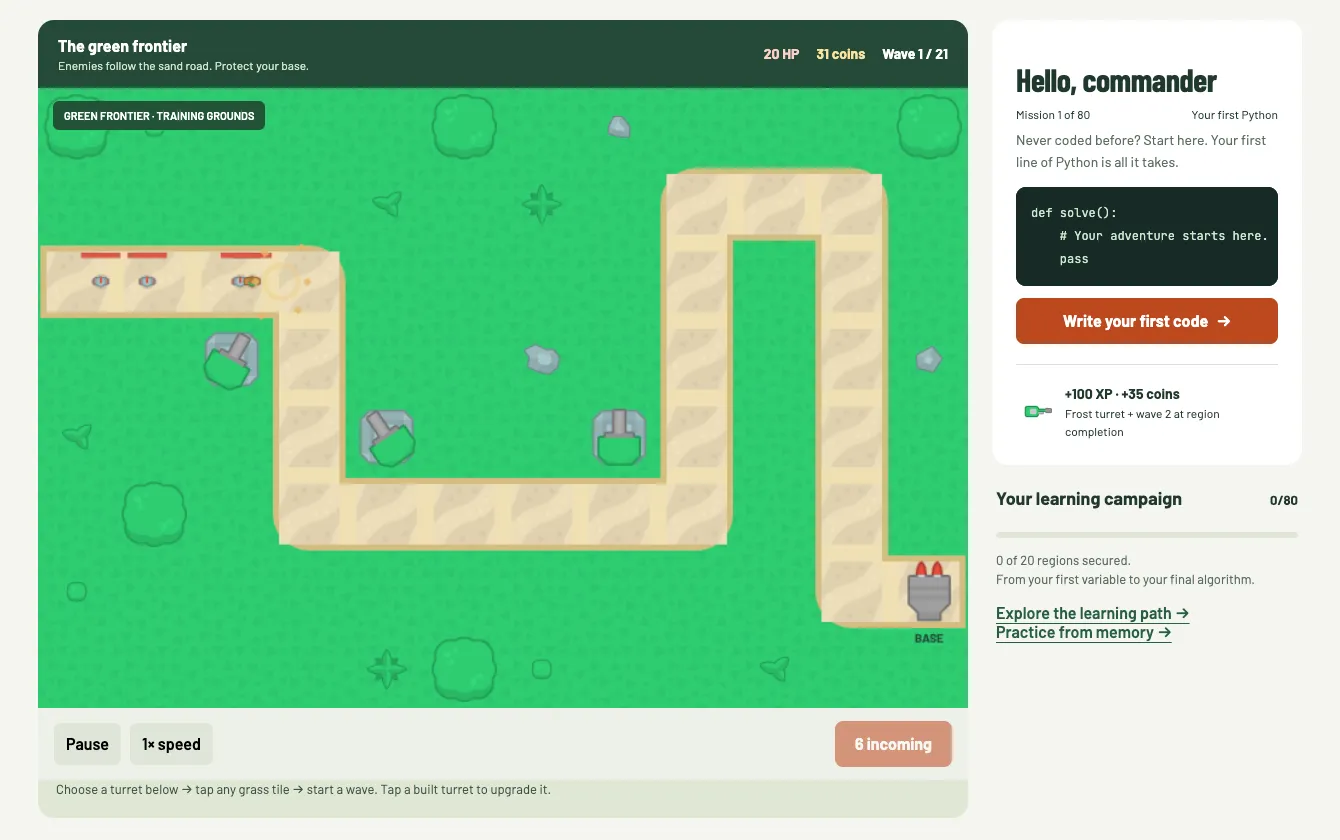
A mobile-friendly tower defense game where you write real Python in the browser to unlock towers and waves.
Independent game, curriculum, and web development
I wanted to get comfortable with Python and interview-style problems. Reading solutions did not make me write code, and a plain problem list was easy to drop.
I built a static tower defense game with 20 regions of four coding missions each. Finishing a region unlocks waves and new towers, and each mission runs your Python against reference checks in the browser.
Pyodide loads in a module Web Worker, so a stuck program cannot freeze the page. A 12-second limit stops runaway code, and the next run starts a fresh worker. Standard-library missions then run on the device.
Enemy movement, targeting, and hits follow a fixed simulation, with Matter.js used only for debris. That let a test win all 21 waves without a person playing. Checkpoints between waves make a retry predictable.
Hints and solutions let a clear count, and a fresh memory attempt asks for it again. A review queue brings missions back at 1, 3, 7, 14, 30, and 60 days. Progress stays in the browser with JSON export and import.
A personal learning project, hosted as a static site with no account or backend. Passing a mission shows the output was right, not that the solution is efficient. The wave simulation shows a winning defense exists, not that the difficulty is tuned, and it has not had human playtesting. The Python runtime loads from a CDN, so the first run needs a connection. The repository is local only.